
–
Opening Reception: Thursday, September 3, 6–8 p.m.
Curators Tour with Adele ᒪᐢᑿᓱᐤᐃᐢᑵᐤ Arseneau: Saturday, September 5, 2–3 p.m.
Tour for Mandarin Speakers: Saturday, September 19, 2–3 p.m.
The Ferry Building Gallery is proud to present Tāpis: A Love Letter to Our Dog Kin.
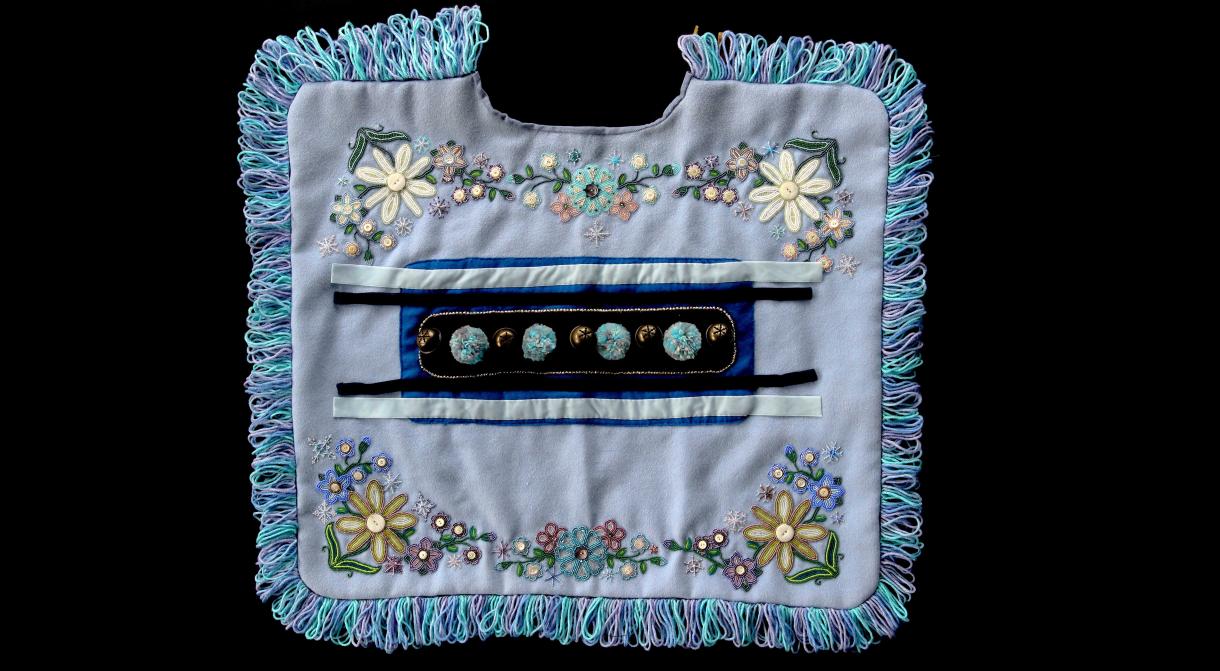
Conceived by Nehiyaw and Michif knowledge keeper, Elder, and multidisciplinary artist Adele ᒪᐢᑿᓱᐤᐃᐢᑵᐤ Arseneau, the exhibition features nine intricately beaded dog blankets, created by Adele ᒪᐢᑿᓱᐤᐃᐢᑵᐤ Arseneau and her students: Dominique Caron, Danielle Courcelles, and Suzan Kostiuck.
This exhibit is a continuation of the journey of reclamation and rebuilding bonds of cultural knowledge. An original reboot of the Tāpis exhibit, it adds three new makers now holding the knowledge of tāpis/tuppies (dog blankets).
When Adele ᒪᐢᑿᓱᐤᐃᐢᑵᐤ asked to be taught this knowledge from her mentor, it was with the intent of restoring important cultural knowledge taken from so many Northern Nations. For this cohort, Adele ᒪᐢᑿᓱᐤᐃᐢᑵᐤ chose makers who exhibited personal and cultural ethics close to her own, along with levels of skill necessary to undertake such a large project. “Each of these blankets takes a minimum of 200 hours (or more) to be brought to completion. It is with great pride to be able to showcase this exhibit. It has been created to show the beauty and celebration of dog regalia as completed by Michif, Dene, and other Nations to celebrate our valued dog kin.”
Originating from the Métis, Northern Cree, and Dene communities, ‘li tāpis’ (small carpet), named by the French Michif and known as ‘tuppies’ by the English and Scottish Michif, are dog blanket regalia created to celebrate dogs. Tāpis are made from wool and embellished with intricate beadwork, silk embroidery, moose or caribou hair tufting, fringed with ribbon or yarn and adorned with bells. Showing respect for sled dogs, tāpis were draped over the backs of dogs.
The blankets served many purposes in the Northern prairies: they were used to keep the dogs warm, to announce the arrival of a dog team into a village, and to identify people at a distance. This highly skilled work was often undertaken by women and was a point of pride. “Dogs are ancestral relatives and integral to our cultural identity. The care for, and kinship with dogs was, and still is, crucial for our survival. They helped us be strong and independent. This sacred relationship was a vital part of how we took care of ourselves and exerted our sovereignty.”
Traditional knowledge about tāpis nearly disappeared over time due to displacement from traditional homelands, the residential school system, and the violence committed against Indigenous dog breeds by the RCMP and Canadian government officials.
About the artists:
Adele ᒪᐢᑿᓱᐤᐏᐢᑵᐤ Arseneau is a disabled multidisciplinary artist, nehiyaw (Cree) and Métis knowledge keeper/Elder with over 40 years of lived cultural experience. Her practice centers storytelling, traditional craftsmanship, and community mentorship to foster cultural resurgence and ethical reconnection.
Born in Prince George and raised among the Dakelh (Carrier) people, Adele’s work bridges her adopted and ancestral roots. Grounded in story as a method of teaching, she works in Métis and Plains-style beadwork, hide tanning, cedar carving, digital media and acrylic/watercolour painting to explore traditional and contemporary Indigenous identities.
She holds diplomas in Fine Art and Graphic Design, completed the Reconciliation Carving Program at Langara College under Squamish Nation master carver Xwalacktun, and a hide tanning residency with Fern and Roe in 2019. She continues to mentor emerging Indigenous tanners across Turtle Island.
An active member of Triia Native Art Collective and Cowichan Valley Arts Council, Adele has exhibited from North Vancouver to Toronto. Her public art for the City of Vancouver reflects the intersections of cultural knowledge, environmental stewardship, and social justice. Through mentorship and deep respect for ancestral teachings, she creates works that honour kin, land, and more-than-human relations.
Dominique Caron (she/her) is a contemporary Métis beadwork artist based in Campbell River, British Columbia, on the traditional territories of the Liǧʷiłdax̌ʷ peoples: the We Wai Kai, Wei Wai Kum, and Kwiakah Nations. This region is also home to the Ayajuthem-speaking peoples of the Homalco, Klahoose, and K’ómoks First Nations.
Although Dominique always knew she was Métis, she grew up largely disconnected from her family and culture. Through her father’s family, she carries strong Métis ancestry connected to the Caron, Boucher, Gervais, Boyer, Bremner, Hogue, and L’Esperance family lines. Her mother’s family is primarily of Scottish and English descent.
Dominique began beading five years ago and has dedicated the past year to exploring and creating Métis heritage arts. Inspired by historic Métis beadwork and treasured heirloom pieces, her work reflects a personal journey of cultural reconnection, learning, and reclamation. Committed to lifelong learning, she is grateful for the teachings shared by Elders and Knowledge Keepers and believes in carrying those teachings forward by sharing her skills with others. Each bead she sews honours her ancestors while celebrating the living traditions, resilience, and enduring artistry of the Métis people.
Danielle Courcelles (all pronouns) is a two-spirit Métis visual artist who love to create memorable art for their loved one, infusing each piece with deep meaning. Building on their needlework skills they've been using since childhood, Danielle has been learning Métis traditional arts, including Métis-style beadwork, regalia, and hide tanning.
They grew up in Cranbrook, BC, and were disconnected from their Métis heritage. Although they knew from childhood they were Métis, they didn’t have relationships with their Métis family members. The opportunity to focus on learning more about their heritage didn’t arrive until they were in their adulthood. To ensure respectful reconnection, they continue to sit and learn with and from Elders and Knowledge Carriers. They take great care when creating Métis artwork to ensure they are following the teachings they learn, while expanding their understanding of these arts and Métis ways of being. Themes they enjoy incorporating into their work includes normalizing death and rebirth cycles, and visual representations of personal relationships.
Although they are an emerging artist, they hope to share their learnings and skills with other Métis community members as a way to honour their mentors and carry on their resurgence work.
Suzan Kostiuck is a formally trained artist and has enjoyed the luxury of appreciation of the arts throughout her life. The written word, performances, culinary, and music are just a few that she has been blessed to be around and to enjoy. However, her greatest enjoyment has been the visual arts. Being able to immerse herself into her creations where the hours pass by unnoticed is something that she absolutely loves and craves.
Suzan is exposed to artwork by other artists on a daily basis, which she finds challenging and pushes her to find her own path. She also comes from a rural area with a beautifully eclectic family, offering her a reminder of how simple life really is.
Suzan studied Visual Art Communications in Medicine Hat, Alberta, and also received her BFA in Visual Arts from the University of Victoria. She continually learns from online courses, internships, mentorships, and workshops. Suzan lives on Vancouver Island, BC, Canada and is a member of the Acho Dene Koe located in Ft. Liard, NWT.
Image/Beadwork © Adele ᒪᐢᑿᓱᐤᐃᐢᑵᐤ Arseneau and is used with permission of the artist.
This exhibition was made possible by a community grant from the West Vancouver Foundation.